

 Natalie Sridharan, MD
Member, AVF Newsletter Committee
 Rabih Chaer, MD, MS
Member, AVF Newsletter Committee
Pulmonary Embolism response teams (PERTs) are created to facilitate rapid and multidisciplinary management of intermediate- and high-risk pulmonary embolism (PE). They can help mobilize resources quickly, drive individualized treatment, and facilitate much-needed research in this field.
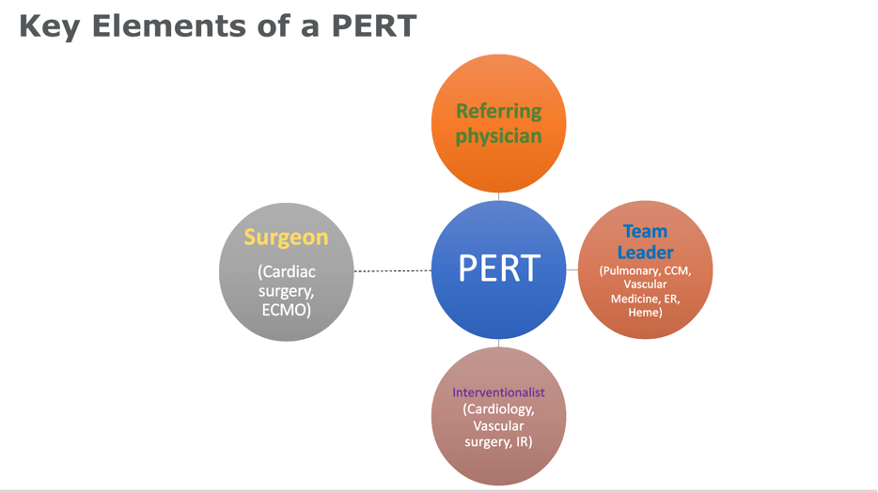
PE remains a highly lethal problem, with mortality rates relatively unchanged in recent times. Transitions of care between emergency room physician, critical care, pulmonary medicine, hematology, and possibly an interventionalist (whether cardiac surgery, vascular surgery, interventional radiology, or interventional cardiology) can be difficult to coordinate and lead to fragmented care. PERTs are valuable for a number of reasons. They facilitate consensus-based treatment plans by experts in medical, surgical, and interventional management strategies which is essential in this pathology where high-quality data often lags behind technological advances to intervene on PE. They also leverage multiple specialties’ clinical expertise and help mitigate bias that one group may have for a treatment type.1
Data suggest that the presence of a PERT increases the number of patients receiving a full PE workup including biomarkers and echocardiography. The presence of a PERT also leads to more specialty consultations and more advanced therapies such as catheter-directed interventions.2
Starting a PERT can be challenging, but many resources are available that suggest best practices for doing so. The make-up of a PERT will vary by institution and local expertise, but in general should incorporate as many key stakeholders as possible. Not all stakeholders will be engaged at every PERT activation but should be aware of the algorithm and ready to assist when called upon.1,3,4 Vascular surgeons are well positioned to start a PERT in their home institutions.
PERT consortium guidelines suggest that established PERTs should be able to meet the following criteria: Ability to rapidly assess and provide treatment for patients with acute pulmonary embolism; a formal mechanism to exercise a full range of medical, surgical, and endovascular therapies; provide appropriate multidisciplinary follow‐up of patients; and a willingness to collect, evaluate, and share data regarding the effectiveness of treatment rendered.
Frequent engagement of key stakeholders as well as administration is necessary during the design phase of a PERT. The true establishment of a PERT is more of an iterative process that involves creation of an algorithm, roll-out, and a commitment to continuous quality improvement and refining the process as issues arise, which are inevitable.
Vascular surgeons are the experts of the vascular system – both arterial and venous. Remaining not only involved, but at the forefront, of the management of PE is important for the well-rounded vascular program. In addition, patients with PE often have other venous disorders including DVT and, in the long term, superficial and deep venous disease and post-thrombotic syndrome, so remaining involved in their care is important for the full-spectrum vascular surgery program.
The role of vascular surgeons in the innovation of minimally invasive approaches to treat PE has been well established for more than 50 years since Dr. Greenfield introduced the pulmonary embolectomy catheter and the vena cava filter(ref). Vascular surgeons have been leaders in clinical research (sunset PE ref) and have contributed to almost all clinical IDE and NIH-sponsored trials in the interventional management of PE. In keeping with the adage that “the needs of the patient come first,” this mandates the inclusion of the ready availability and involvement of vascular surgeons in PERTs.
References:
- Rosovsky R, Zhao K, Sista A, Rivera-Lebron B, Kabrhel C. Pulmonary embolism response teams: Purpose, evidence for efficacy, and future research directions. Res Pract Thromb Haemost 2019;3(3):315-330. DOI: 10.1002/rth2.12216.
- Hussein EA, Semaan DB, Phillips AR, et al. Pulmonary embolism response team for hospitalized patients with submassive and massive pulmonary embolism: A single-center experience. J Vasc Surg Venous Lymphat Disord 2023;11(4):741-747 e2. DOI: 10.1016/j.jvsv.2023.03.002.
- Bejjani A, Khairani CD, Campia U, Piazza G. Pulmonary Embolism Response Teams: Theory, Implementation, and Unanswered Questions. J Clin Med 2022;11(20). DOI: 10.3390/jcm11206129.
- Porres-Aguilar M, Rosovsky RP, Rivera-Lebron BN, et al. Pulmonary embolism response teams: Changing the paradigm in the care for acute pulmonary embolism. J Thromb Haemost 2022;20(11):2457-2464. DOI: 10.1111/jth.15832.