
 Keith Sterling, MD
Senior Medical Director, Vascular Therapies
Boston Scientific Corporation
Patients with severe acute pulmonary embolism (PE) may display a range of clinical characteristics contributing to risk of early decompensation or death. Anticoagulation remains the standard of care for all patients with acute PE, with additional catheter-based options available for patients at higher risk.(1)
The benefit of catheter-based reperfusion with ultrasound-assisted catheter-directed thrombolysis (EKOSTM Endovascular System, Boston Scientific) with anticoagulation over anticoagulation alone has now been demonstrated in the randomized HI-PEITHO trial.(2) Prior to HI-PEITHO, systemic fibrinolysis had shown efficacy in preventing hemodynamic collapse but with increased major bleeding risk (3) and direct comparisons between catheter-directed therapy and anticoagulation alone were lacking.
The EKOS system employs high frequency, low power ultrasound energy to facilitate catheter-directed infusion of thrombolytic agents to the pulmonary vasculature. The adjunctive ultrasound energy may allow for lower dose and duration of fibrinolytic infusion to reduce clot burden and improve right ventricular function.(4)
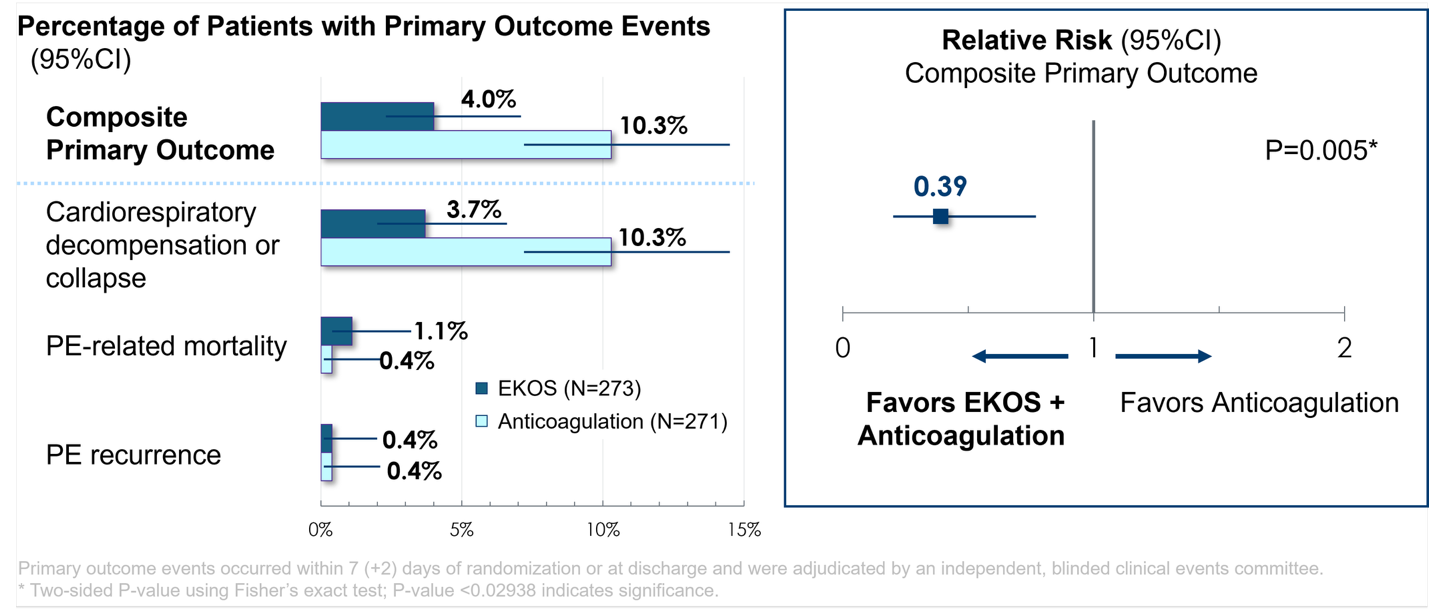
The randomized HI-PEITHO study was designed to compare incidence of the composite of PE-related mortality, cardiorespiratory decompensation or collapse, and symptomatic PE recurrence within 7 days of randomization.(2) National Early Warning Score (NEWS) was included in the criteria for assessing decompensation to allow for objective monitoring and documentation of vital status prior to escalating treatment.
This multicenter (59 sites), multinational (9 countries) study enrolled 544 patients who had intermediate risk PE and additional indicators of cardiorespiratory distress. Results showed that patients who received treatment with EKOS plus anticoagulation had a lower risk of the composite endpoint events than patients who received anticoagulation alone. Importantly, no significant difference was observed between treatment groups in the incidence of major bleeding, and no intracranial hemorrhage occurred within 30 days.
HI-PEITHO is the first randomized controlled trial evaluating clinically meaningful endpoints in patients with acute pulmonary embolism who underwent catheter-based intervention. The results provide high-caliber evidence supporting the use of EKOS for reducing decompensation risk without increasing major bleeding risk for patients with acute intermediate risk PE.
References:
- Creager MA, et al. 2026 AHA/ACC/ACCP/ACEP/CHEST/SCAI/SHM/SIR/SVN Guideline for the Evaluation and Management of Acute Pulmonary Embolism in Adults. J Am Coll Cardiol 2026. doi:10.1016/j.jacc.2025.11.005
- Rosenfield K, Klok FA, Piazza G, et al. Ultrasound-Facilitated, Catheter-Directed Fibrinolysis for Acute Pulmonary Embolism. N Engl J Med. 2026;394(20):1979-1990. doi:10.1056/NEJMoa2516567
- Meyer G, Vicaut E, Danays T, et al. Fibrinolysis for patients with intermediate-risk pulmonary embolism. N Engl J Med. 2014;370(15):1402-1411. doi:10.1056/NEJMoa1302097
- Tapson VF, Sterling K, Jones N, et al. A Randomized Trial of the Optimum Duration of Acoustic Pulse Thrombolysis Procedure in Acute Intermediate-Risk Pulmonary Embolism: The OPTALYSE PE Trial. JACC Cardiovasc Interv. 2018;11(14):1401-1410. doi:10.1016/j.jcin.2018.04.008