

 Daniella Kadian-Dodov, MD
Associate Professor of Medicine, Vascular Medicine
Mount Sinai Fuster Heart Hospital
Icahn School of Medicine at Mount Sinai
The 2026 multi-societal guideline for the evaluation and management of acute pulmonary embolism (PE) provides a contemporary framework spanning diagnosis, risk assessment, treatment, and post-PE follow-up.1 The most consequential change is the introduction of the AHA/ACC Acute Pulmonary Embolism Clinical Categories ranging from Category A– representing asymptomatic or incidentally detected PE, through Category E– representing established cardiopulmonary failure (Figure 1).
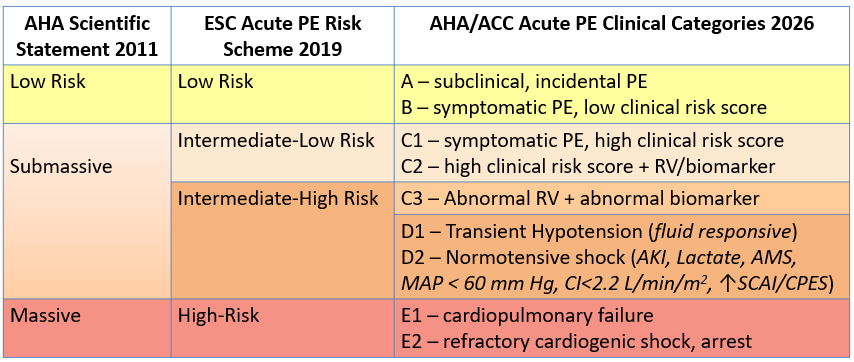
The new framework moves beyond the traditional terms “massive,” “submassive,” and “low-risk PE” used in the 2011 American Heart Association scientific statement, while adding granularity to the 2019 European Society of Cardiology risk classification (Figure 2).2,3 Prior systems grouped patients with substantial clinical heterogeneity and could inadvertently overemphasize radiographic clot burden. The 2026 categories incorporate clinical severity, right ventricular function, biomarkers, hemodynamic compromise, and a respiratory modifier intended to capture hypoxemia and respiratory compromise more precisely. The practical message is to treat the patient’s physiology and trajectory, not the appearance of clot alone.
Anticoagulation remains the foundation of therapy, with direct oral anticoagulants preferred over vitamin K antagonists in eligible patients. Selected patients in Categories A and B many be managed as outpatients when validated tools support a low risk of adverse events and reliable follow-up is available. Patients in Categories C through E generally require hospitalization with monitoring and treatment intensity matched to clinical severity.
This guideline does not support routine intervention for all patients with right ventricular dysfunction or biomarker elevation. Anticoagulation and surveillance remain central in Category C, while advanced therapies become more relevant for patients in Categories D and E. Multidisciplinary management teams (eg, PE Response Teams–PERTs) can facilitate individualized decisions based on clinical trajectory, bleeding risk, and institutional availability and expertise.
Finally, a PE case does not end at discharge. Early medication follow-up with a care provider, reassessment at 3 months, and continued monitoring for persistent symptoms and functional impairment are essential components of longitudinal care.
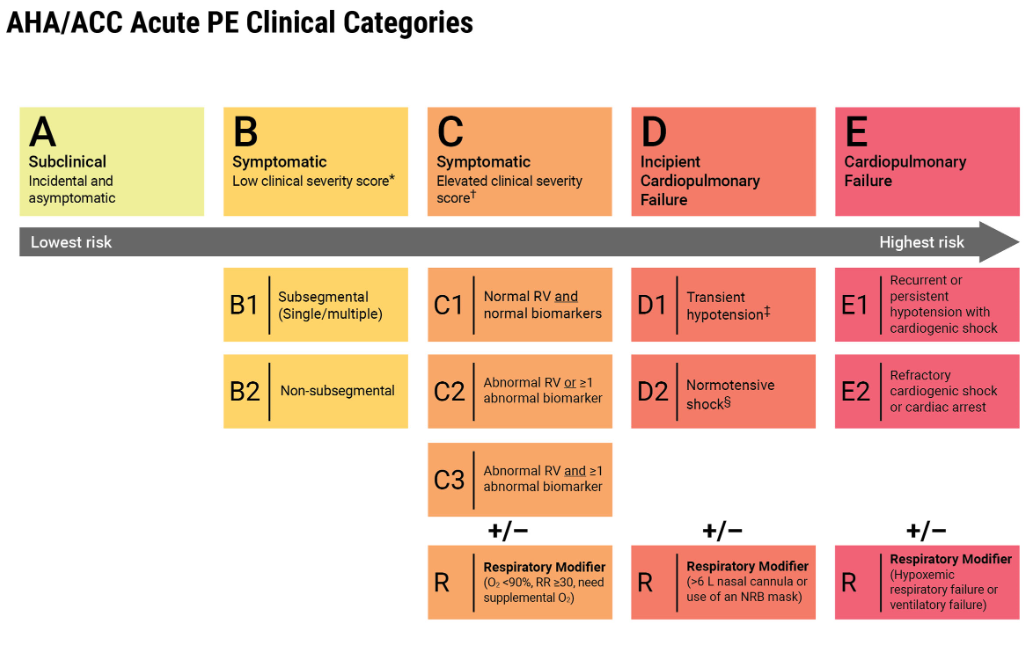
*Low Clinical Severity Score includes PESI≤85 or sPESI=0 or BOVA<4. †Elevated Clinical Severity Score includes PESI>85 or sPESI≥1 or BOVA>4.
‡Systolic blood pressure <90 or decrease >40 mm Hg lasting <15 min or responding to IV fluids. §Any: Lactate >2 mmol/L, acute kidney injury, urine output <0.5 mL/kg/hr, mental status change, cardiac index <2.2 L/min/m2, mean arterial pressure <60 mm Hg, increased shock score/stage (SCAI stage, CPES score). ACC indicates American College of Cardiology; AHA, American Heart Association; CPES, Composite Pulmonary Embolism Shock; IV, intravenous; NC, nasal cannula; NRB, nonrebreather; O2, oxygen; PE, pulmonary embolism; PESI, Pulmonary Embolism Severity Index; RR, respiratory rate; RV, right ventricle; and sPESI, simplified PESI.
References:
- 2026 AHA/ACC/ACCP/ACEP/CHEST/SCAI/SHM/SIR/SVM/SVN Guideline for the Evaluation and Management of Acute Pulmonary Embolism in Adults: A Report of the American College of Cardiology/American Heart Association Joint Committee on Clinical Practice Guidelines. Circulation 2026;153(12):e977-e1051.
- 2019 ESC Guidelines for the diagnosis and management of acute pulmonary embolism developed in collaboration with the European Respiratory Society (ERS). Eur Heart J 2020;41:543-603.
- Management of Massive and Submassive Pulmonary Embolis, Iliofemoral Deep Vein Thrombosis, and Chronic Thromboembolic Pulmonary Hypertension: A Scientific Statement from the American Heart Association. Circulation 2011;123(16):1788-1830.