

 Vic Tapson, MD, FCCP, FRCP
Professor of Medicine
Division of Pulmonary and Critical Care
Cedars-Sinai Medical Center
Sr. Director, Medical Affairs
Stryker PV
Acute pulmonary embolism (PE) causes tremendous early mortality with approximately 100,000 deaths per year in the United States–amounting to one death every 5 minutes. In fact, several sources suggest that mortality may, in fact, be increasing over the past several decades.1,2
But potential longer-term sequelae cannot be ignored. Disagreements have arisen regarding terminology, and “post-PE syndrome” has often served as an umbrella term that includes symptoms due to deconditioning, anxiety, coexisting illnesses, and quality of life that persist for longer than 3 months after the initial acute PE event, as well as those that are derived directly from obstruction by chronic thromboembolism.3
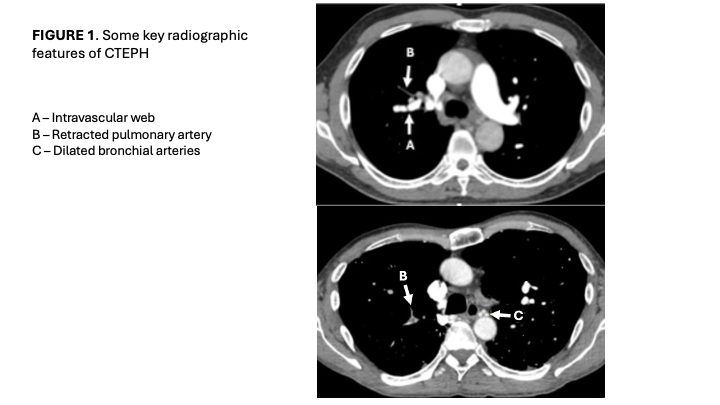
The most devastating form of post-PE syndrome is chronic thromboembolic pulmonary hypertension (CTEPH), which occurs in approximately 3% of acute PE patients. The time delay between onset of symptoms and diagnosis and referral to an expert pulmonary hypertension center is often more than one year, and the majority of patients present with advanced symptoms of dyspnea with exertion. While prognosis is poor in untreated patients, CTEPH can be cured by pulmonary endarterectomy, although only a handful of expert surgical centers in the US perform more than 50 of these cases per year. In certain Western European countries, there is often a single national expert center. In patients who are not candidates for surgical endarterectomy (often due to more distal obstruction), extensive experience now exists with balloon pulmonary angioplasty.4 A computed tomographic angiogram image showing key features of CTEPH is shown in Figure 1.
Persistent symptoms after acute PE should be evaluated with echocardiography as a screen to determine whether pulmonary hypertension (CTEPH) is present; if so, a more detailed evaluation including right-heart catheterization is undertaken. If there is no pulmonary hypertension, but persistent CT scan abnormalities are present, further evaluation is necessary to sort out the potential cause to determine whether the persistent vascular changes are, in fact, causing symptoms. Cardiopulmonary exercise testing has become increasingly useful in this regard.
Finally, we must determine if PE interventions such as catheter-directed thrombolysis or catheter embolectomy cause problematic sequelae, Large randomized clinical trials suggest that while complications can occur, including major bleeding or pulmonary artery perforation, these are very rare, and these procedures can avoid potentially catastrophic complications such as intracranial hemorrhage caused much more frequently by systemic thrombolysis.5
References:
- Casey SD, Stubblefield WB, Luijten D, et al. Addressing the rising trend of high-risk pulmonary embolism mortality: Clinical and research priorities. Acad Emerg Med. 2024; 31:288-292.
- Martin KA, Molsberry R, Cuttica MJ, et al. Time trends in pulmonary embolism mortality rates in the United States, 1999 to 2018. J Am Heart Assoc. 2020; 9(17) e016784.
- Morris TA, Dakaeva K, Alotabi M, et al. Chronic thromboembolism phenotypes after acute pulmonary embolism: identification with the SEARCH algorithm. Eur Respir J 2026 68(2): 2501562.
- Jais X, Tapson V, Fernandes TM, et al. Diagnosis of chronic thromboembolic pulmonary hypertension. J Heart Lung Transplant 2025; 44(7S): S1-S7.
- Jaber WA, Gonsalves CF, Stortecky S, et al. Large-bore mechanical thrombectomy versus catheter-directed thrombolysis in the management of intermediate-risk pulmonary embolism: primary results of the PEERLESS randomized controlled trial. Circulation 2025; 151(5): 260-273.